


Decoding a VIN: How Is It Done?
Drivers who have purchased a car in the U.S. or another country often encounter the VIN and need to know how to interpret it correctly. This is necessary for ordering auto parts, verifying the vehicle’s history when purchasing it, or preparing it for a future sale.
What Is a VIN?
A VIN is a unique identification number assigned to each vehicle during manufacturing at the factory. It consists of numbers and letters of the Latin alphabet—17 characters in total. By decoding the VIN, you can obtain complete information about the vehicle—from its year of manufacture, make, and model to the presence or absence of specific equipment in the factory-spec version of the car. But these are only the basic parameters encoded in symbols and numbers. There may be other vehicle specifications.
It’s important to verify a vehicle using its VIN when ordering a car from abroad and when signing a purchase agreement in Ukraine. Correctly deciphering a vehicle’s unique identification number helps not only when purchasing new parts but also when inspecting the vehicle during the purchase process and finalizing the contract. This information reveals details about accidents, criminal incidents, replacements of critical parts, and much more—which may serve as a reason to decline the purchase.
VIN Code: What It Consists Of
The VIN consists of three parts that must be deciphered in sequence. Each part contains important information about the vehicle, which, when correctly interpreted, helps reveal the car’s history, its features, and distinctive characteristics.
The first part of the VIN
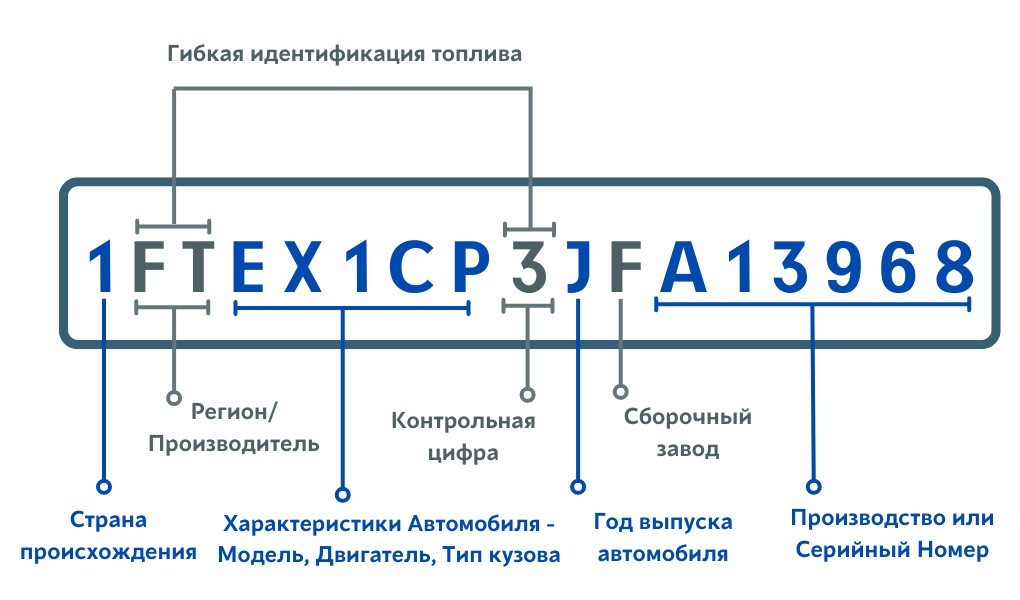
The first part of the VIN is called the World Manufacturer Identifier, or WMI. It contains information about the vehicle’s origin. This code is assigned to the vehicle by the Society of Automotive Engineers, which is based in Pennsylvania (USA). Virtually all vehicles are assigned a unique number by this organization.
The first character indicates the geographic region, the second character indicates the country of manufacture, and the third character indicates the manufacturing plant. Decoding this part of the code is fairly straightforward:
- digits 1–5 are for U.S. vehicles;
- letters S–Z – European vehicles;
- codes X3–X9, X0, Z7–Z0 represent the Russian automotive industry.
However, some automakers that began operations during the Soviet era have not changed their designations and continue to use their original codes. For example, the VIN code for vehicles manufactured by the Ulyanovsk Automobile Plant (UAZ) is XTT, by the Izhevsk Automobile Plant is HTK, and by AvtoVAZ is HTA.
The Second Part of the VIN
This part of the VIN serves a descriptive purpose and is designated by the abbreviation VDS. It identifies the vehicle model and consists of six digits (the fourth through the ninth).
Each character has a specific meaning:
- the fourth digit indicates the vehicle’s body type;
- the fifth digit indicates the engine type;
- the sixth digit indicates the vehicle model and its variant;
- the seventh and eighth digits provide information about the brakes, maximum allowable weight, model series, and much more;
- the ninth digit serves as a check digit and is used to prevent tampering with the number, allowing the vehicle identification number to be correctly determined.
Please note! If five digits are used, the last (ninth) digit will be a dash or a zero.
The ninth digit can also be used to determine whether the code has been damaged or illegally altered.
The third part of the VIN
The third part is called the VIS and is used as a distinguishing identifier. It consists of 8 digits or letters. Its interpretation begins with the tenth character of the VIN:
- the first character indicates the year the vehicle was manufactured;
- the second indicates the assembly plant;
- the third through eighth characters indicate the vehicle’s serial number.
It’s a good idea to pay attention to the third part of the VIN right away. This is especially important when buying any vehicle manufactured abroad. Some sellers may list a different, earlier production year in order to sell the vehicle at a higher price.
The VIN can be found on the front door pillar or under the hood. In rare cases, it is located elsewhere: on the steering wheel or steering column, inside the left wheel well, on the soundproofing panel, or on a label near the windshield.

When checking the VIN, you should look not only for the presence of the vehicle identification number itself but also at its condition. If it shows signs of damage, tampering, or is illegible, it’s best to avoid purchasing that vehicle. Any defects in the code may indicate a serious accident or a criminal history associated with the vehicle. This will also make it difficult to register the vehicle.
If a driver does not know or cannot recall the meaning of the VIN, there are various services available to decode the unique number. This allows you to purchase a vehicle that has not been in an accident and has no criminal history, or to order the correct parts.
Sometimes cars of the same make and model, but with different years of manufacture, have different trim levels and non-interchangeable parts. It’s impossible to determine this by sight alone, so parts are selected using the VIN code.
A vehicle’s unique identification number is also helpful during legal proceedings when it is necessary to prove the owner’s innocence or right of ownership.
Be sure to check the vehicle and its VIN! If you can’t do this on your own, contact specialists who can help you choose a car and decipher its identification number.
Need advice?
Fill out the contact form, and our managers will get in touch with you shortly!


